
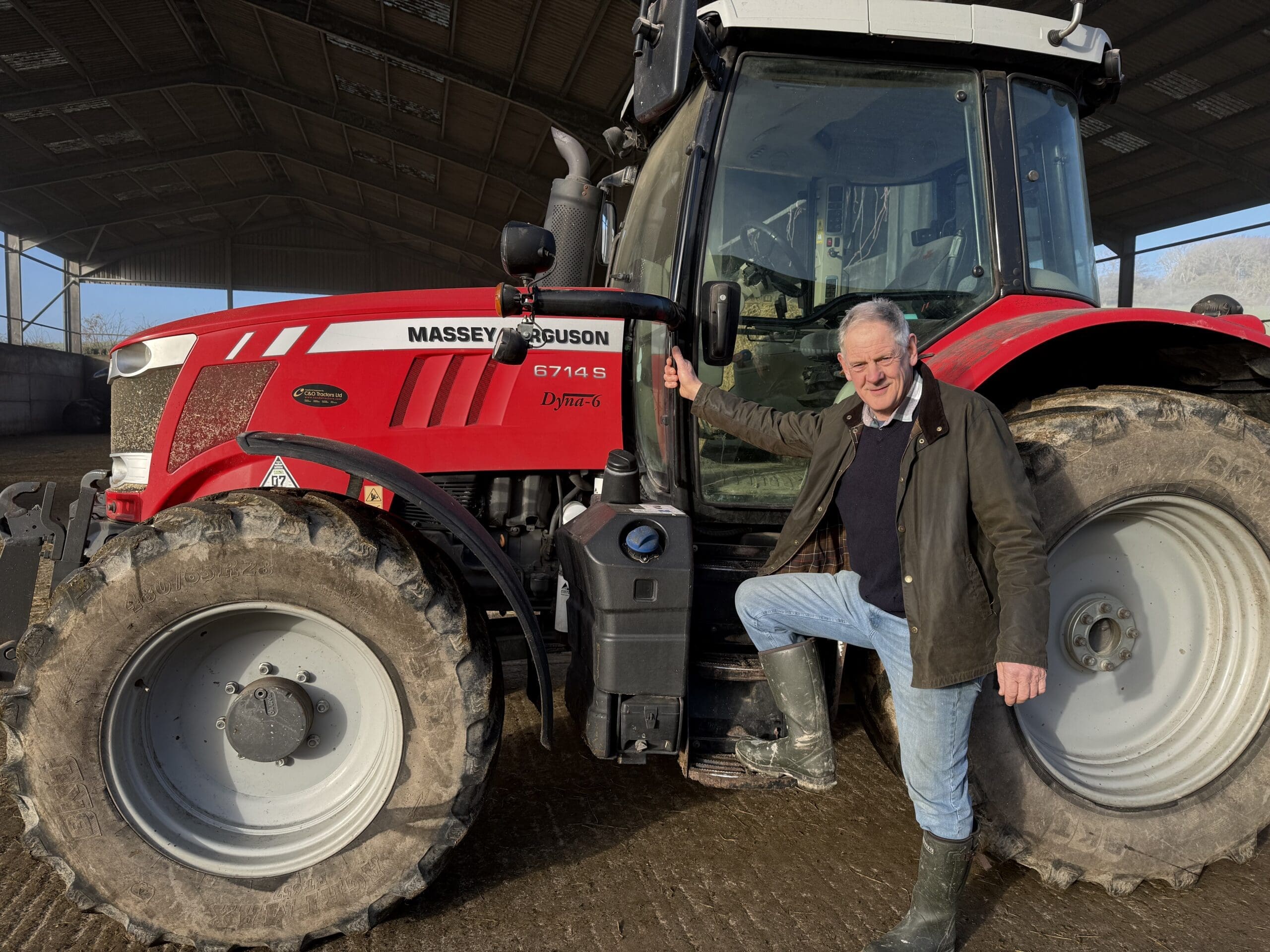
But for John, a tenant farmer on Droke Farm in West Sussex, success has never come from standing still. It’s come from steady, considered change: taking on the tenancy in his mid-twenties, moving the dairy herd to a new site, transitioning to organic production, and building a farm business that now supports three generations of his family.
A Farm Built on Generations
John took on the tenancy of the farm’s two holdings aged just twenty-six, after his father died in 1981. “I was fortunate because I was here working on the farm,” he says. “But it was still a lot of responsibility to take on.”
What followed was a farm shaped by careful, commercially minded decisions rather than dramatic reinvention. In 2008, John consolidated two farmsteads into one, using the proceeds from the site he closed to build a new dairy. The herd expanded, and the farm’s focus shifted increasingly towards dairy, with less emphasis on arable and beef.
When his son, Harry, came home to work on the farm, John introduced a flock of sheep to give him an enterprise to develop of his own. It was Harry who later suggested going fully organic — an idea John had considered previously but not progressed with back in the nineties.
The Move to Organic: A Considered, Commercial Decision
“I’ve never enjoyed applying chemicals – you just think of it as a necessity,” John explains. But rather than making the switch on principle alone, he modelled it first: “It wasn’t until I sat down and looked at the difference in price, did a forecast and a cash flow going forward to see what the profit and loss would look like, that I felt confident.”
The farm gave up its arable sales entirely, growing everything for its own livestock instead. Yields dropped, particularly in the early years, but the numbers held up – helped by a strong organic milk contract, which included support during the two-year conversion period. Looking back, John is in no doubt it was the right call: “Given how low conventional milk and cereal prices are, it’s fair to say that we may have been struggling today if we hadn’t changed then. I think we’ve future-proofed the business.”
The benefits have gone far beyond just the balance sheet though. John has seen a marked increase in bird life on the farm, confirmed by bird surveys carried out fifteen years apart, and puts it down to no longer spraying insects that birds depend on for food. “I think I’m surprised at how well the crops do most years,” he says – including a spring barley crop grown on nothing but farmyard manure that matched what the farm used to produce conventionally.
A Family Business, Diversified
Today, the farm is a genuine family operation. John’s wife is a partner in the business, his son works full-time – now also managing the neighbouring Goodwood Farm on a partnership basis — and his daughters each bring their own contribution, from bookkeeping to running farm walks and forest school sessions for local children.
Around the core farming business, the family has built a handful of small diversifications: a self-service milk and milkshake vending machine, a weekend coffee hut, padel courts and a sauna in a converted grain barn, and, most recently, container storage. None of these individually earns a fortune, but together they bring the public onto the farm and give the next generation room to build their own ventures. “It’s a nice thing to do because it gets people onto the farm,” John says.
National Recognition
In January, John’s contribution to farming was recognised in the New Year Honours List, with a British Empire Medal (BEM) – a moment he still describes as a complete surprise. “Totally shocked – I had no idea at all,” he recalls.
Day to day, little will change on the farm – John is characteristically modest about the honour. But it stands as fitting recognition of the vision, hard work and quiet determination that have shaped the farm over four decades, from taking on the tenancy in his mid-twenties through to building a resilient, award-winning organic business today.
Keeping a Close Eye on the Numbers
For all the farm’s success, John is clear that none of it happens without careful financial management. “It’s incredibly important – planning ahead, knowing what our costs and likely income are going to be, doing cash flows going forward, and making sure our enterprises are profitable,” he says. “These things matter a lot more when margins get narrow and cash flow gets tight.”
That discipline is built around KEYPrime Accounts, which John has used for a long time and knows well. John says he welcomes the simplicity of the software “I only really use the simple stuff,” he says, “but I do a cash flow using the cash flow facility, so I can see how my cash flow looks over the next twelve months.” With a seasonal business – milk income tails off mid-year before calving brings it back up, just as contractor costs for silage-making and manure spreading start to climb – that visibility matters. “I need to make sure there’s enough there, to see us through,” he explains.
John also relies on KEYPrime for day-to-day reporting – pulling feed cost reports or splitting out costs between the dairy herd and youngstock, when he needs to. “I know where to go to pull a report,” he says. And when he does need help, he knows it’s there: he recently had support from the Landmark team to work through his year-end. “That was great,” he says. “The support is there, and I probably phone up once or twice a year too.”
Looking Ahead
John’s ambitions for the farm are far from finished. He’s planted around 3,500 trees and hedge plants on the land and hopes – grants permitting – to extend hedge and tree planting across the wider farm, linking existing hedgerows and woodland into wildlife corridors and restoring field boundaries that existed generations ago. It’s an endeavour he is clearly passionate about.
The farm is also adapting to a changing climate, with new fans installed in the milking parlour and cow yards to help the herd cope with rising temperatures, and a gradual cross-breeding programme underway to develop a smaller, hardier, better-grazing cow suited to summer grazing.
It’s a farm shaped by patience, family and careful decision-making – qualities that, alongside the numbers John keeps close track of, look set to successfully carry it through to a fourth generation.